Social protection and the limits to climate adaptation: An exploration
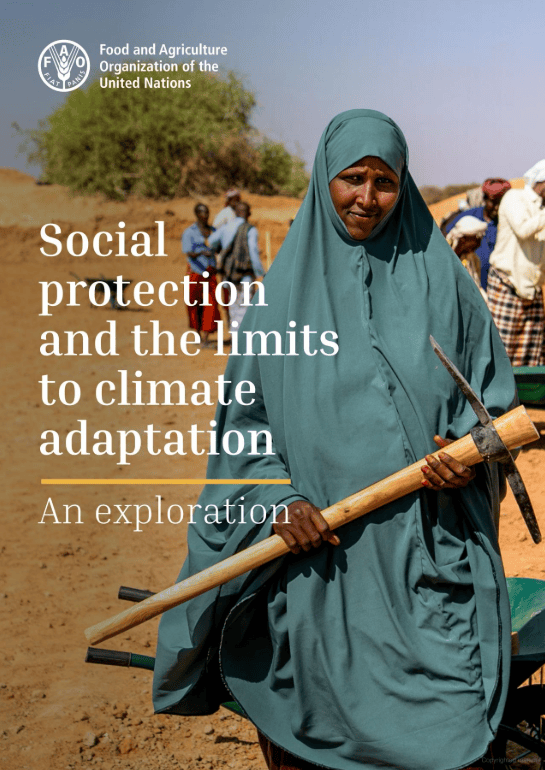
In May 2026, the Food & Agriculture Organization (FAO) formally launched a milestone report at the Bonn Climate Change Conference, titled “Social protection and the limits to climate adaptation: An exploration,” authored by Anna McCord, Matthew Walsham, Marco Knowles, and Neema Patel. This report challenges us to move beyond thinking about climate hazards and confront a more difficult question: how can we strengthen the contribution of social protection to adaptation, while also preparing for situations where adaptation itself may no longer be enough? Climate change is increasingly undermining small-scale agricultural livelihoods. While social protection systems can play a critical role in supporting inclusive and resilient climate adaptation, this study highlights that there are limits to what adaptation can achieve and explores scenarios both before and after limits to adaptation are reached, clarifying how social protection can better address the evolving risks facing smallholders. It concludes with a call for early, coordinated dialogue and action – rooted in scientific evidence, scenario modelling and cross-sectoral collaboration – to ensure that social protection systems are equipped to respond effectively to adaptation limits.
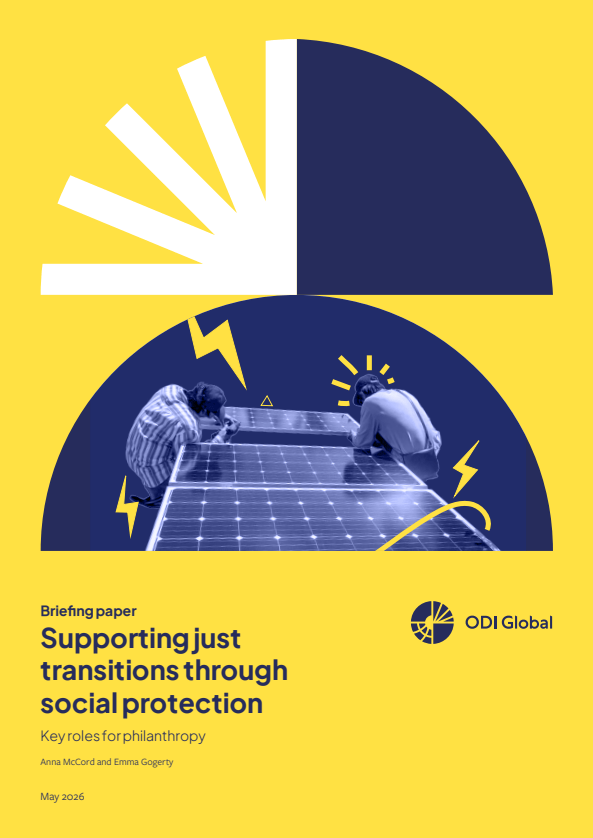
This briefing paper, published by ODI Global Risks and Resilience in May, coauthored by Anna McCord and Emma Gogerty looks at how philanthropies can contribute to ensuring a just transition to net zero, through the extension of social protection to address poverty and income security.
Supporting just transitions through social protection: key roles for philanthropy
Links to previous events in 2025
I curated a socialprotection.org webinar series on contemporary issues in Public Works programming in April, May, and December 2025, which included a paper I co-edited with colleagues at the World Bank, looking at recent innovations in public works programming.
The three-part webinar series explored key contemporary issues in public works programming.
Public Works in a Changing Geopolitical and Climate Context: Lessons for the Future
Each session was based on recent publications from the ILO, ODI/SPARC, and the World Bank, critically examining policy, design, political economy, evaluation, impact, and innovation in public works programs. Bringing together experts from various sectors, including social protection, employment, rural livelihoods, and the environment, the series fostered dialogue, shared lessons, and enhanced future program design and implementation.
First of the series: 17th April 2025, 2pm (GMT)
Anna moderated the webinar:
This webinar examined the challenges and trade-offs in public works programs aiming to balance social protection, employment, and asset creation, while exploring their broader policy implications and providing guidance on effective program design.
This webinar is based on the ILO paper ‘Public employment programmes at the intersection of employment and social protection policies‘
Second in the series: 22nd May 2025, 2pm (GMT)

Drawing lessons from a retrospective study of the impacts of assets for natural resource management in Ethiopia and Kenya in order to learn lessons about PWP design and implementation, and how, when to use PWP.
This webinar was based on the SPARC/ODI paper: Do public works programmes create valuable assets for livelihoods and resilience? A retrospective study of the impacts of assets for natural resource management in Ethiopia and Kenya.
Third in the series: 11th December 2025, 2pm (GMT)
The webinar explored how a new generation of public works programs (PWPs) is responding to challenges of climate change, gender inequalities, demographic shifts, and digital transformation. The starting point for the discussion was a forthcoming study by the World Bank that examines three new types of PWPs: (a) ‘green PWPs’ that focus on climate and environmental challenges; (b) ‘digital PWPs’ that leverage digital technologies; and (c) ‘care-providing PWPs’ that enhance the provision of care services. The webinar highlighted how these new approaches to PWP design and implementation can achieve benefits beyond social protection and thus potentially increase the positive impact of PWPs.
October 2025
How Social Protection Can Help the Fund for responding to Loss and Damage to Achieve its Goals: A Primer
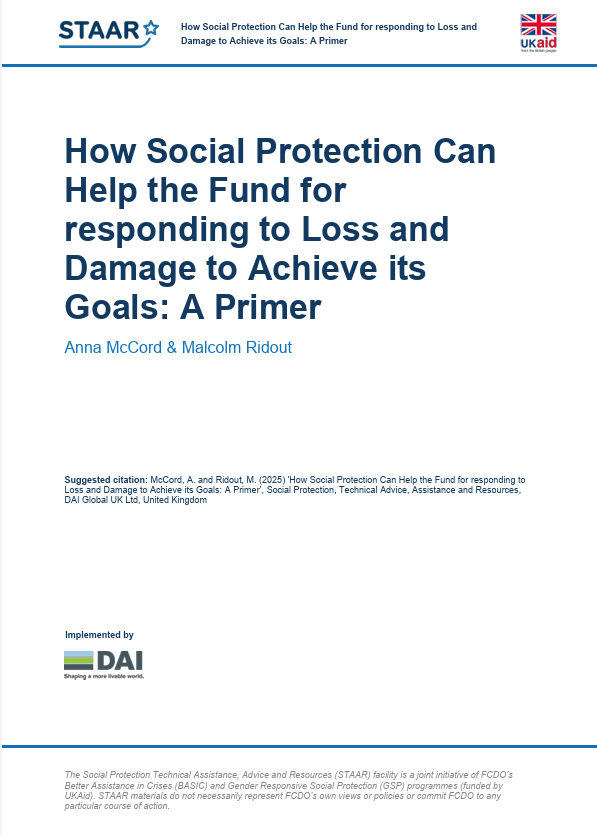
This paper produced with Malcolm Ridout for STAAR and financed by FCDO is intended as a primer for climate and social protection actors on how social protection can address loss and damage challenges and help the new Fund for responding to Loss and Damage to achieve its objectives. It is designed to inform an evidence-based approach to incorporating social protection into policy and financing discussions concerning loss and damage – the negative effects of climate change that occur despite mitigation and adaptation efforts – and to provide recommendations on how social protection might be used to contribute to the objectives of the newly created Fund for responding to Loss and Damage (FRLD). The paper outlines how social protection instruments can be utilised to respond to climate-induced loss and damage, providing many examples and drawing on recent experiences to illustrate how social protection mechanisms can be adapted to facilitate efficient and targeted, nationally led responses to loss and damage.
September 2025

This primer sets out the range of challenges that climate change presents for poor and vulnerable people in the Global South and the ways that philanthropy can support social protection systems to respond to these needs. Social protection systems need to respond, and there are various operational arenas in which that response needs to occur.
Climate-Responsive Social Protection: A Primer for Philanthropy
January, 2024
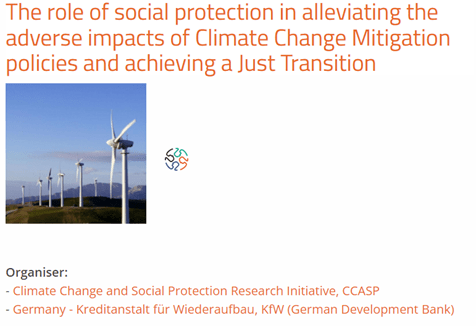
This webinar shares findings from a recent study comissioned by KFW and prepared by Anna McCord and Cecilia Costella of CCASP
Read the report: Pathways for Social Protection in the Just Transition of Low- and -Middle Income Countries.
The report draws on recent literature to explore the impacts of three major CCM approaches – Energy Subsidy Reform (ESR), Carbon Taxation and the green transition – on poverty, and summarises how social protection can be used to mitigate these negative impacts and promote the acceptability of CCM interventions, contributing to the realisation of a Just Transition. It also sets out practical recommendations for designing and implementing social protection systems to support these three CCM approaches, including recommendations for development partner investment.
December 2023
Finalisation of the STAAR Social Protection and Climate Change Key Stakeholder Mapping
Check out this mapping which sets out key current and recent initiatives by the main international actors taking forward the climate change and social protection agenda.
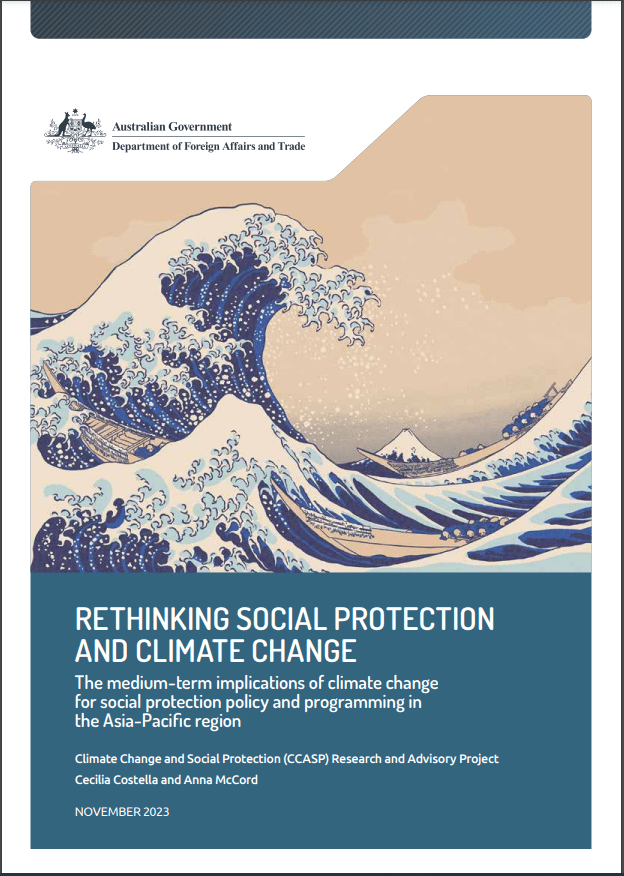
Prepared by Climate Change and Social Protection (CCASP) Research Initiative, funded by the Australian Department of Foreign Affairs and Trade, read the report that explores the implications of climate change for future social protection provision.
November 2023
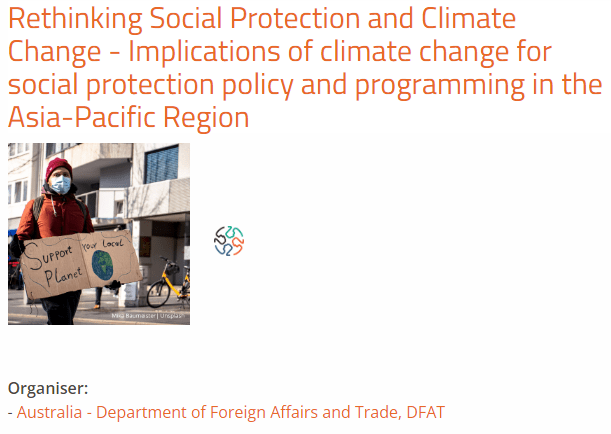
Listen to Anna McCord presenting key findings of CCASP research report for DFAT
Rethinking Social Protection and Climate Change – Implications of climate change for social protection policy and programming in the Asia-Pacific Region
Links to previous events in 2025
I curated a socialprotection.org webinar series on contemporary issues in Public Works programming in April, May, and December 2025, which included a paper I co-edited with colleagues at the World Bank, looking at recent innovations in public works programming.
The three-part webinar series explored key contemporary issues in public works programming.
Public Works in a Changing Geopolitical and Climate Context: Lessons for the Future
Each session was based on recent publications from the ILO, ODI/SPARC, and the World Bank, critically examining policy, design, political economy, evaluation, impact, and innovation in public works programs. Bringing together experts from various sectors, including social protection, employment, rural livelihoods, and the environment, the series fostered dialogue, shared lessons, and enhanced future program design and implementation.
First of the series: 17th April 2025, 2pm (GMT)
Anna moderated the webinar:
This webinar examined the challenges and trade-offs in public works programs aiming to balance social protection, employment, and asset creation, while exploring their broader policy implications and providing guidance on effective program design.
This webinar is based on the ILO paper ‘Public employment programmes at the intersection of employment and social protection policies‘
Second in the series: 22nd May 2025, 2pm (GMT)
Drawing lessons from a retrospective study of the impacts of assets for natural resource management in Ethiopia and Kenya in order to learn lessons about PWP design and implementation, and how, when to use PWP.
This webinar was based on the SPARC/ODI paper: Do public works programmes create valuable assets for livelihoods and resilience? A retrospective study of the impacts of assets for natural resource management in Ethiopia and Kenya.
Third in the series: 11th December 2025, 2pm (GMT)
The webinar explored how a new generation of public works programs (PWPs) is responding to challenges of climate change, gender inequalities, demographic shifts, and digital transformation. The starting point for the discussion was a forthcoming study by the World Bank that examines three new types of PWPs: (a) ‘green PWPs’ that focus on climate and environmental challenges; (b) ‘digital PWPs’ that leverage digital technologies; and (c) ‘care-providing PWPs’ that enhance the provision of care services. The webinar highlighted how these new approaches to PWP design and implementation can achieve benefits beyond social protection and thus potentially increase the positive impact of PWPs.

