 I have been working on the emerging issue of climate change and social protection for several years and have coauthored a number of papers. In 2022 I co-founded the Climate Change and Social Protection (CCASP) Research Initiative to explore in depth the implications of climate change for social protection needs, and the ways that the sector will need to adapt to respond to changes in the patterns of poverty, ranging from programme conceptualisation and design, to policy alignment and even international and national institutional architecture. CCASP was initially funded by DFAT to take forward work in relation to the Asia Pacific Region, and KFW to explore issues relating to social protection responses to the adverse effects of Climate Change Mitigation (CCM) policies.
I am now leading CCASP, with administrative and web support from Daniela Baur.
How Social Protection Can Help the Fund for responding to Loss and Damage to Achieve its Goals: A Primer
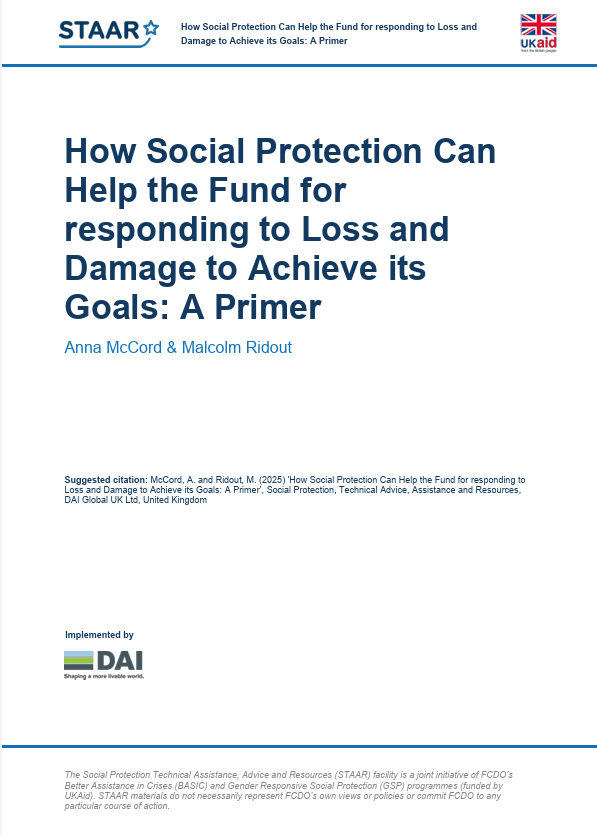
This new paper produced with Malcolm Ridout for STAAR and financed by FCDO is intended as a primer for climate and social protection actors on how social protection can address loss and damage challenges and help the new Fund for responding to Loss and Damage to achieve its objectives. It is designed to inform an evidence-based approach to incorporating social protection into policy and financing discussions concerning loss and damage – the negative effects of climate change that occur despite mitigation and adaptation efforts – and to provide recommendations on how social protection might be used to contribute to the objectives of the newly created Fund for responding to Loss and Damage (FRLD). The paper outlines how social protection instruments can be utilised to respond to climate-induced loss and damage, providing many examples and drawing on recent experiences to illustrate how social protection mechanisms can be adapted to facilitate efficient and targeted, nationally led responses to loss and damage.

This primer sets out the range of challenges that climate change presents for poor and vulnerable people in the Global South and the ways that philanthropy can support social protection systems to respond to these needs. Social protection systems need to respond, and there are various operational arenas in which that response needs to occur.
Climate-Responsive Social Protection: A Primer for Philanthropy
Integrating climate change into social protection programmes and policy
Prepared for FCDO by the Social Protection Technical Assistance, Advice and Resources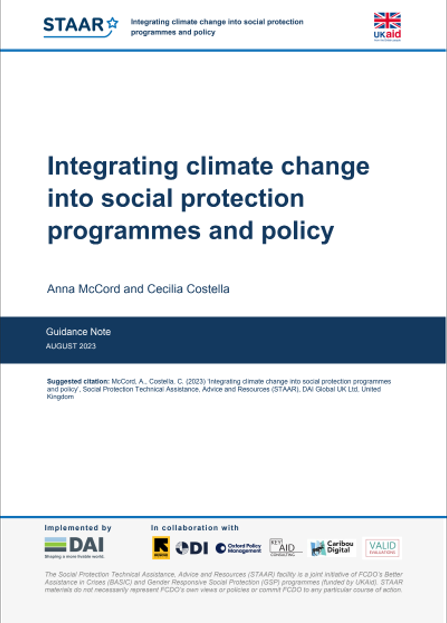 (STAAR) to provide guidance to practitioners working on social protection, and specifically to:
- Highlight the relevance of climate change to social protection and explain why it is important to consider climate change as part of social protection policy, programming and systems.
- Present ideas for integrating climate change considerations into social protection policy and programming.
- Point to relevant resources on climate change and social protection.
In December 2023 DFAT published the major report prepared by CCASP which explores the implications of climate change for future social protection provision.
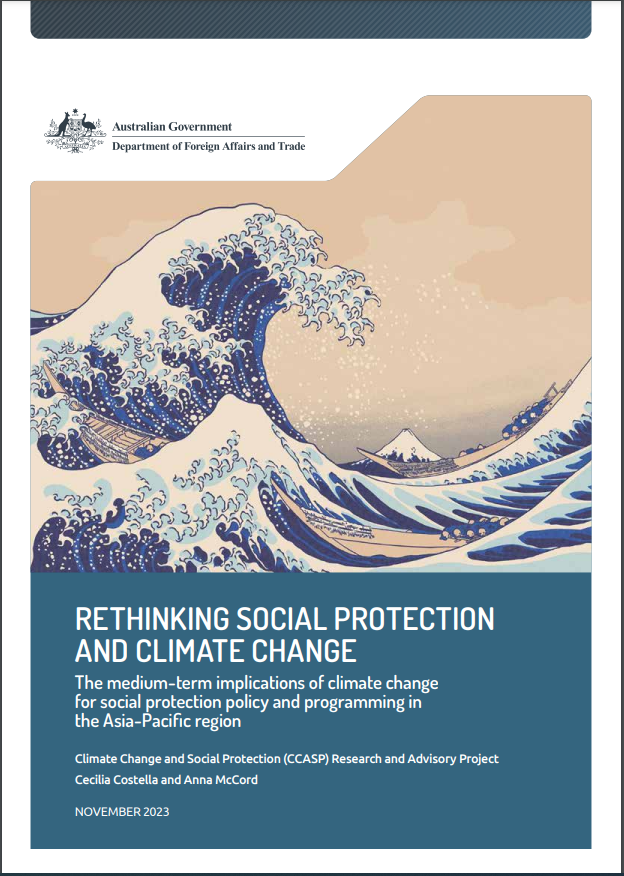
In the report by the Australian Department of Foreign Affairs and Trade, Cecilia Costella and I argue that, while social protection has the potential to play an important role in helping to manage climate challenges and enable the structural changes required to achieve a green transition, existing social protection systems will need significant transformation in terms of scale and design.
In the report, we have taken an in-depth look at the impacts of climate change in the Asia-Pacific region over the next 30 years, and propose that:
- Social protection strategic vision, institutions, and programming needs to accommodate the profound implications of climate change in terms of scale, type, duration, and spatial distribution of social protection needs in the medium term.
- This requires radical rethinking across six domains: institutions and mandates; policy alignment; coverage and targeting; instrument and program design; operational systems; and financing.
- Overall, it will require a significant shift of global ambition, vision and urgency of social protection policies and institutions.
The key findings of the report were presented and discussed at a socialprotection.org Webinar moderated by DFAT in November 2023.
Climate Change and Social Protection Stakeholder Mapping
CCASP has also prepared a report: Climate Change and Social Protection Stakeholder Mapping for the Social Protection Technical Assistance, Advice, and Resources Facility (STAAR).
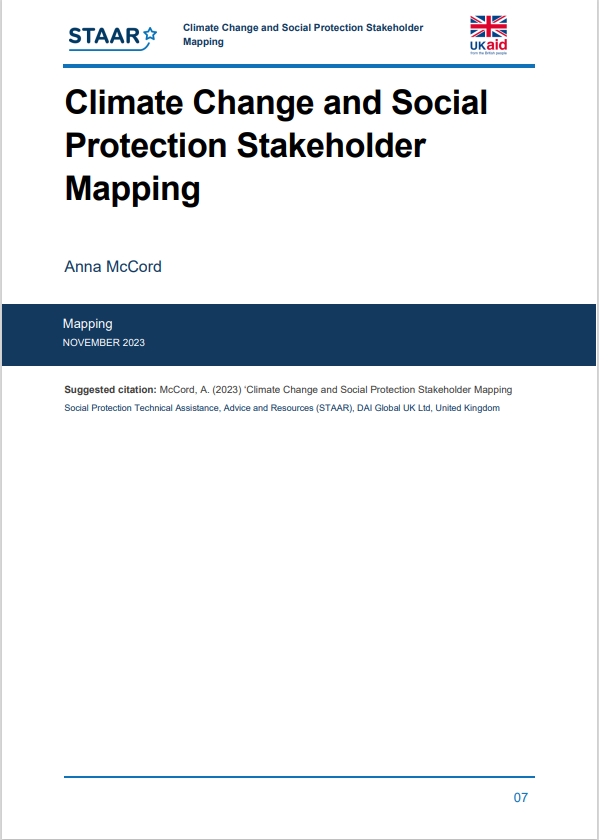 This mapping sets out key current and recent initiatives by the main international actors taking forward the climate change and social protection agenda. It sets out the focus areas of the bi and multi-lateral donor agencies and UN agencies currently leading work on social protection and climate change and the work they are involved in to take forward the climate and social protection agenda, with links to key initiatives, publications and events, but is not an exhaustive listing of all activity in the sector. It is intended to inform and support the development of social protection programming and policy which will accommodate to the growing challenge of climate change. It is one of three outputs financed by the FCDO and produced by STAAR, the other two being a checklist for the integration of climate change into social protection programming and set of potential programming entry points to take forward the climate and social protection discourse.
KfW
CCASP has also prepared a report for KfW on the role of social protection in relation carbon change mitigation, a series of guidance outputs for the FCDO on Climate and Social Protection through the STAAR initiative, including a Mapping of Key Stakeholder initiatives published in November 2023, and a Thematic Guidance Note and Quick Tips note on social protection the environment and climate change for the European Commission.
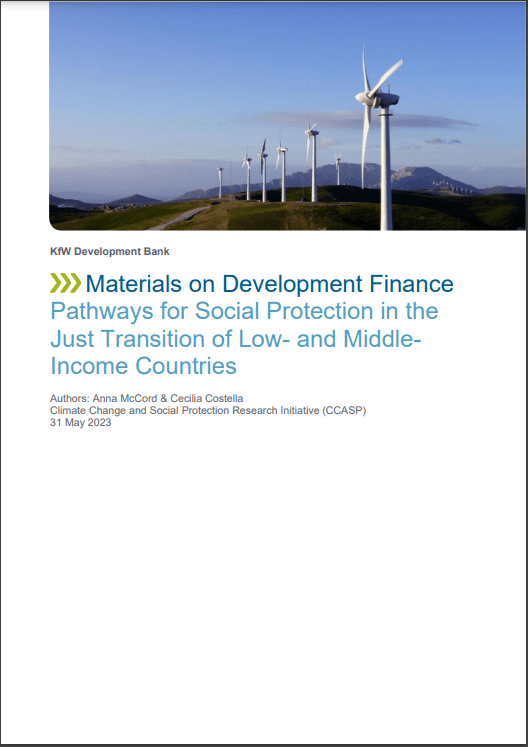
Check out newly published report
Pathways for Social Protection in the Just Transition of Low- and Middle-Income Countries
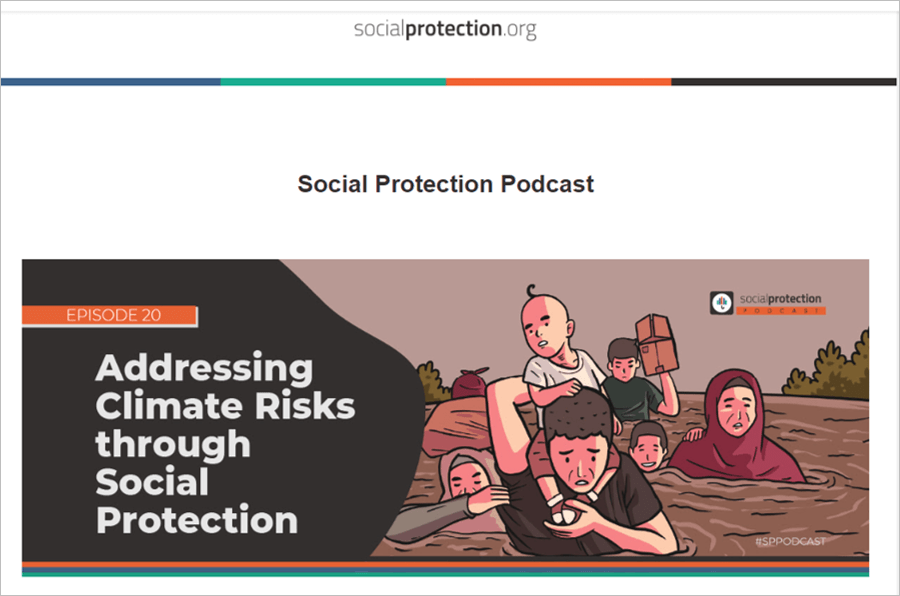
Listen to Cecilia Costella on the Social Protection Podcast on:
Addressing Climate Risks through Social Protection
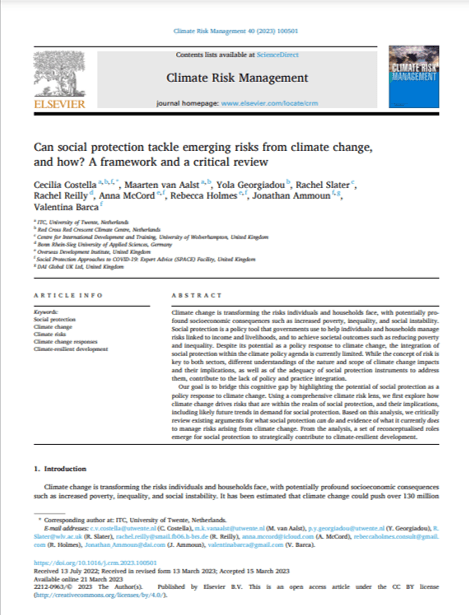
All contributions on the podcast are based on the paper co-authored with Anna and others:
In my work on social protection and climate change, I am trying to look at the implications of climate change for the current social protection discourse and identify innovations in programming which are starting to take the socio-economic impacts of geophysical change into account and may offer options for future design. Every aspect of the current social protection discourse will be challenged in the coming decades and we are working to support new thinking in terms of design, delivery, financing, and scale. We are currently taking this work forward through the CCASP Climate Change and Social Protection research initiative funded by DFAT.
I am also working with the USB2030 Working Group on Climate Change hosted by socialprotection.org.
Key reads


 Anna McCord